Home »
Author: Dr Richard Chen-Yang
Chiropractor at Mt Eden Chiropractic
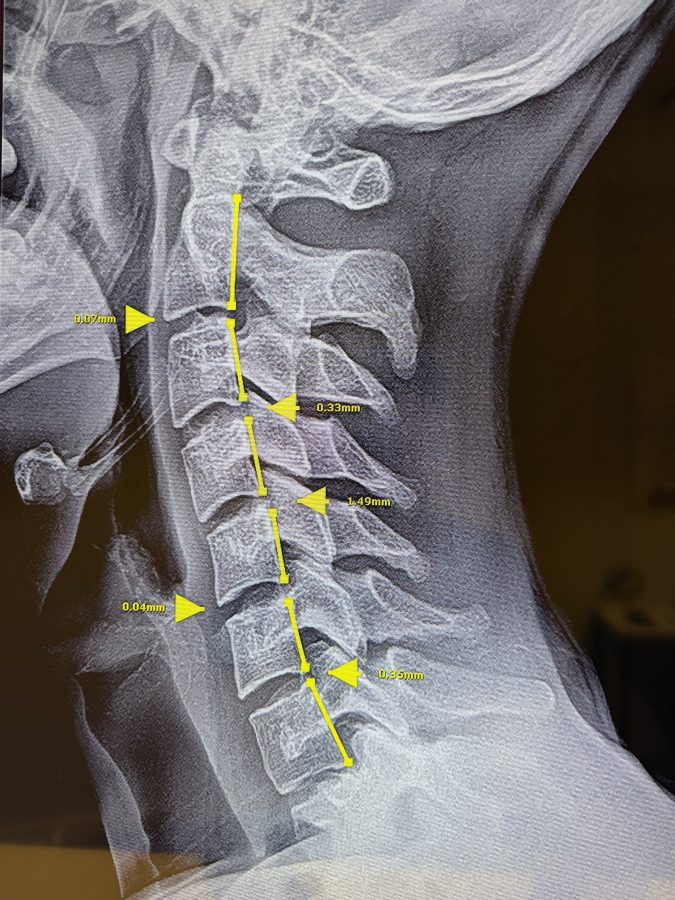
The images below show the progress of a university student who initially came to us for low back pain. He also reported frequent brain fog and occasional headaches.
During his care, we identified that he had a noticeable forward head posture, which he felt was related to the long hours he spent studying and sitting at a desk. Once his initial symptoms had improved, which was for his low back pain, he wanted to take the next step and work on his spinal alignment.
As part of his corrective care, we introduced the Denneroll orthotic device, which he committed to using consistently at home each day.
After six months of care and regular Denneroll use, we took a follow-up X-ray to measure his progress. The changes in his neck alignment were noticeable.
More importantly, he reported feeling better in his day-to-day life, with improved posture, more relaxed shoulders, fewer headaches and an improvement in the brain fog he had previously experienced.
This is a great example of why feeling better doesn’t necessarily have to be the end of care. Once the initial symptoms had settled, he chose to build on that progress through consistent care and the use of an additional corrective tool.
The result? We didn’t just look at how he felt: we were also able to measure the changes over time.”

Many people first seek chiropractic care when pain, stiffness, headaches or reduced mobility begin affecting their everyday life.
The initial phase of care focuses on helping you feel better and function better. But once you start feeling better, what happens next?
The next phase is about building on that progress rather than simply waiting for the next symptom to appear.
Think about the Titanic. What sank the Titanic: the part of the iceberg you could see, or the much larger part beneath the surface?
Symptoms can be similar. What we feel is often what brings us in, but there may be other factors contributing to the problem that aren’t immediately obvious.
This is why corrective care can look beyond symptoms and consider the structure, movement and function of the spine.
One approach we may incorporate into corrective care is specific chiropractic adjustments with techniques such as traction, with a focus on improving measurable aspects of spinal posture and alignment over time.
For example, where appropriate, we may use a Denneroll as part of care for the neck. The neck is also known as the cervical spine, and the Denneroll is designed to provide a specific form of cervical traction. We can assess whether it is suitable for you and teach you how to use it correctly at home.
Our bodies are designed to adapt. But adaptation requires consistency.
Think about going to the gym. You don’t train for a few months, reach your goal, and then expect your strength and fitness to remain exactly the same if you never exercise again.
The same principle applies to your spine and overall function.
Feeling better is an important milestone, but it doesn’t necessarily mean that everything contributing to the problem has changed, or that you will stay feeling that way indefinitely without continued care and healthy habits.
Corrective care is about building on the progress you’ve already made. This may mean continuing with regular chiropractic adjustments, with additional tools or strategies such as the Denneroll incorporated when appropriate.
As you progress, the focus and frequency of care can change. The goal isn’t to keep you in an intensive phase of care forever. It’s about helping you make progress, maintain that progress, and continue looking after your spine before the next problem forces you to.
Relief is important. When pain or stiffness is affecting your everyday life, helping you feel and move better is the first priority.
But feeling better doesn’t necessarily mean you’re now “fixed” or that the problem can never return.
Feeling better is the first step. Corrective care is about building on that progress and staying consistent so you can maintain it for the long term.
At Mt Eden Chiropractic we work individually with our patients to formulate a plan for your own short term and long term care. Get in touch with us to learn more, or book an appointment with our Auckland based Chiropractors.