Home »
Mt Eden Chiropractic | Updated 2026
Written by Dr Simon Kelly and Dr Richard Chen-Yang, Chiropractors at Mt Eden Chiropractic
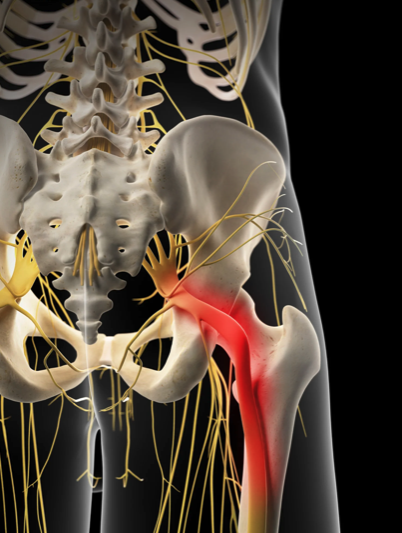
A very common reason people visit us chiropractors for help is sciatica. Over the years, we have seen thousands of people experiencing these symptoms. This updated blog explains the different types of sciatica, some conditions that can mimic it, what we may do in practice, and a few things you can do at home.
People often describe any low-grade leg pain as “sciatica”. The real deal can feel very different: sharp or shocking pain down the back of the leg, sometimes combined with numbness, weakness, pins and needles, or difficulty lifting the leg to get out of bed, a chair or the car.
In simple terms: sciatica describes pain and other symptoms travelling along the pathway of nerves that contribute to the sciatic nerve. The important part is working out what is irritating those nerves.
Diagram shows how sciatic-type pain can travel from the lower back or buttock into the leg.
Not every pain in the buttock or leg is coming from a pinched nerve in the lower back. These are some of the common “sciatica impersonators” we help people navigate:
Piriformis syndrome: A deep muscle in the buttock can tighten or become irritated around the sciatic nerve, causing pain that can feel like a pinched nerve from the spine.
Sacroiliac (SI) joint dysfunction: Problems around the joint connecting the spine and pelvis can refer pain into the buttock and back of the thigh.
Hip joint problems: Hip arthritis, labral tears or impingement can send pain into the groin, hip and thigh. We assess these and, if needed, can recommend appropriate imaging or specialist referral.
High hamstring tendinopathy: Irritation of the hamstring tendon at the base of the pelvis creates deep buttock pain. We see this regularly in active Kiwis.
Vascular claudication: Reduced blood flow in the legs from narrowed arteries can cause cramping and pain during walking and may mimic nerve compression. This is more common as people get older and requires medical assessment.
Spinal arthritis: Wear-and-tear changes in the lower back can contribute to pain and, when they reduce the space around a nerve, may contribute to leg symptoms.
Vertebral subluxation / spinal dysfunction: Within chiropractic practice, altered spinal or pelvic joint function, muscle imbalance and nerve irritation are assessed as possible contributors to a person’s symptoms.
Related reading: Piriformis Syndrome – Mt Eden Chiropractic
Our chiropractors have advanced training in a number of techniques, including Applied Kinesiology (AK). This is one of the techniques we use when assessing and helping people with sciatica.
We use manual muscle testing alongside the rest of the physical examination to look for structural, biochemical or neurological imbalances that may be contributing to irritation around the sciatic nerve. Rather than focusing only on the painful part of the leg, we look at how the pelvis, spine and surrounding muscle chains interact.
Pelvic and Sacroiliac (SI) joint realignment: Sciatica can be associated with pelvic and SI joint dysfunction. AK practitioners may test muscles such as the gluteus maximus and piriformis, then use specific manual adjustments — including low-force techniques such as Thompson Terminal Point — where appropriate to improve pelvic mechanics and reduce irritation around the area.
Targeted muscle balancing: The sciatic nerve passes very close to the piriformis muscle and, in some people, through part of it. If testing identifies an overly tight piriformis or weakness in an opposing or supporting muscle such as the psoas or gluteus medius, we may use myofascial release and muscle-balancing techniques.
Neurolymphatic and neurovascular reflex stimulation: AK also uses specific reflex points as part of its approach to muscle function. For sciatica, a practitioner may stimulate neurolymphatic or neurovascular points alongside treatment of the spine, pelvis and surrounding muscles.
Dural tension release: The dura is the protective membrane around the spinal cord and nerve roots. Where examination suggests increased neural or dural tension, we may assess cranial and sacral mechanics and use gentle sacral or soft-tissue techniques to reduce tension and improve comfortable movement.
To support your care between visits, these two simple exercises can be helpful for some people. They should feel gentle — not like you are aggressively stretching an irritated nerve.
1. Sciatic nerve flossing (neural glide)
Sit upright in a chair. Slowly straighten the affected leg while gently tilting your head back. Then lower the leg while bringing your chin toward your chest. Try 10-15 smooth repetitions.
Watch the exercise: Sciatic Nerve Floss (YouTube Short)
2. Supine Figure-4 stretch
Lie on your back with your knees bent. Cross the ankle of the painful side over the opposite knee. Gently draw the supporting leg toward your chest until you feel a comfortable stretch through the buttock. Hold for around 20–30 seconds.
Watch the exercise: Supine Figure-4 Stretch (YouTube Short)
If an exercise noticeably increases shooting pain, numbness or weakness, stop and have it assessed.
For many people, chiropractic care can be appropriate when the cause and severity of the symptoms have been assessed first. We use specific techniques following a thorough consultation and physical examination, and adapt care to the individual.
We also screen for red flags – signs that the problem may need urgent medical assessment rather than, or before, conservative care.
Spinal stenosis is another important cause of sciatic-type symptoms, particularly as we get older. It means the space available for the nerves in the spinal canal has become narrower.
This narrowing can develop with osteoarthritis and other age-related changes, including bone spurs, thickened ligaments and disc changes. When there is less room for the nerve roots, people may experience pain, tingling, numbness, heaviness or weakness in one or both legs. Symptoms are often worse with standing or walking and may ease with sitting or bending forward.


Both can cause sciatica, but they are different problems. A simple way to think about them is:
Spinal stenosis = less room for the nerves. The canal or nerve-exit spaces become narrower, usually from a combination of age-related changes. Symptoms often build gradually and may be brought on by standing or walking.
Disc herniation = disc material irritating a nerve. Part of a spinal disc pushes beyond its usual boundary and may inflame or compress a nearby nerve root. This often causes sharper radiating pain, pins and needles, numbness or weakness down one leg.
A disc herniation can also contribute to spinal stenosis if it takes up enough space in the canal. Imaging can help in selected cases, but the scan always needs to be considered together with the person’s symptoms and examination.
Common clues with lumbar spinal stenosis
Feature Lumbar spinal stenosis Lumbar disc herniation What is happening? The spinal canal or nerve-exit spaces become narrower, usually because of a combination of degenerative changes such as joint enlargement, thickened ligaments, disc bulging and bone spurs. Part of an intervertebral disc pushes through or beyond its normal boundary and can inflame or compress a nearby nerve root. Typical age/pattern More common with increasing age, particularly after 50, although younger people can be affected. Can occur at many adult ages and may follow gradual disc degeneration or, sometimes, a lifting/twisting episode. Leg symptoms May affect one or both legs. Heaviness, aching, numbness, tingling or weakness can appear with standing or walking. Often produces sharper radiating pain, numbness, tingling or weakness in the distribution of one affected nerve root, commonly on one side. What often aggravates it? Standing and walking, especially with the lower back extended. Symptoms may improve with sitting or bending forward. Certain spinal movements, prolonged sitting, coughing or sneezing can aggravate symptoms in some people. Key point Stenosis is a narrowing problem and may involve several structures and more than one nerve root. A herniation is a disc problem that may irritate or compress a particular nerve root. A disc herniation can also contribute to stenosis if it significantly narrows the available space.
If your leg pain is severe, getting worse, repeatedly returning, or is accompanied by numbness or weakness, it is worth having it properly assessed. The goal is to work out what is actually driving the symptoms rather than simply treating every leg pain as “sciatica”.
Our chiropractors assess the lower back, pelvis, hips, muscles and nervous system to help determine whether your symptoms fit with nerve-root irritation, a disc problem, spinal stenosis, muscular referral or another cause.
From there, we can discuss whether chiropractic care, soft-tissue work, rehabilitation and home exercises are appropriate — and when imaging, medical assessment or specialist referral may be the better next step.
You can also read our previous article: Sciatica: Understanding Its Causes and How Chiropractic Care May Help
This blog provides general health information and does not replace an individual assessment or medical advice.